
What industrial buyers need from your website before they enquire


An industrial buyer visiting your website needs to work out whether your business can meet a particular requirement. That might be a replacement component, equipment for a new production line or maintenance support at a specific site.
Your pages should help them assess the fit and prepare a useful enquiry. Start with the questions your sales and technical teams regularly ask before they can advise or quote. Those questions provide a practical starting point for your website content.
Explain the applications you support
A broad product list leaves buyers to work out which option suits their application. Group information around recognisable uses, with links to the relevant products or services.
Explain the materials, processes or operating environments you support, where relevant. State important limitations clearly. If suitability depends on an assessment, say what needs checking.
Distinguish between manufacturing, distributing, installing and servicing. Buyers should be able to understand your role without assuming you provide everything connected with a product.
Put specifications in context
Use consistent units and explain the conditions attached to performance figures. Dimensions, capacity, connections, materials and compatibility may all matter, depending on what you supply. Your technical team should decide which details belong on each page.
Separate standard features from optional configurations. Make the model or variant clear so a buyer can tell which information applies to the item they are considering.
Put the essential facts on the page and link to detailed documents. Label downloads with the product name and revision or date where applicable. Check that the page and document agree before publishing either.
Show evidence relevant to the requirement
Give buyers something specific they can assess: a product drawing, a documented application, a test report or photographs that explain the work. Use material you have permission to publish and describe what it demonstrates.
Where certification is relevant, identify what it covers. A statement about a product, facility or management system should not suggest that every part of the business has the same approval.
Keep evidence current and connected to the relevant product or service. If project details are confidential, explain the capability using a clearly labelled demonstration rather than presenting it as client work.
Make supply and support arrangements clear
Technical suitability is only part of the decision. Explain the areas you supply or service and whether delivery, installation, commissioning, training or maintenance is available.
Distinguish between your own services and arrangements provided through another business. State which details need confirmation for the particular project.
If availability or lead time varies, explain what affects it, such as configuration, stock or site requirements. Avoid publishing a fixed promise that your team cannot keep current.
For quotations, identify the factors that shape the price and scope. Buyers should know which details you need before you can give a meaningful answer.
Help buyers prepare a useful RFQ
A request for quotation, or RFQ, should give your team enough information to assess the work. Publish a short guide to the details that help, rather than expecting buyers to know your internal requirements.
Depending on the enquiry, these might include the application, quantity, operating conditions, site location, required date and a drawing or part reference. Explain which details are essential and which can follow after an initial discussion.
Tell buyers how to arrange sharing confidential drawings or specifications through an appropriate agreed channel. Let them indicate what they are still unsure about.
Hypothetical equipment enquiry
Suppose a business is considering equipment to label containers. Its initial enquiry could describe the container and label, required output, available space, site location and any connection to existing equipment.
The supplier’s page could explain which container types it handles, what needs checking and which photographs or drawings would help assess the application. The buyer can then send relevant information without selecting a machine before the supplier has reviewed the requirement.
This is an illustrative example, not an Alchemy client project or a recommendation for a particular machine.
A checklist for one product or service page
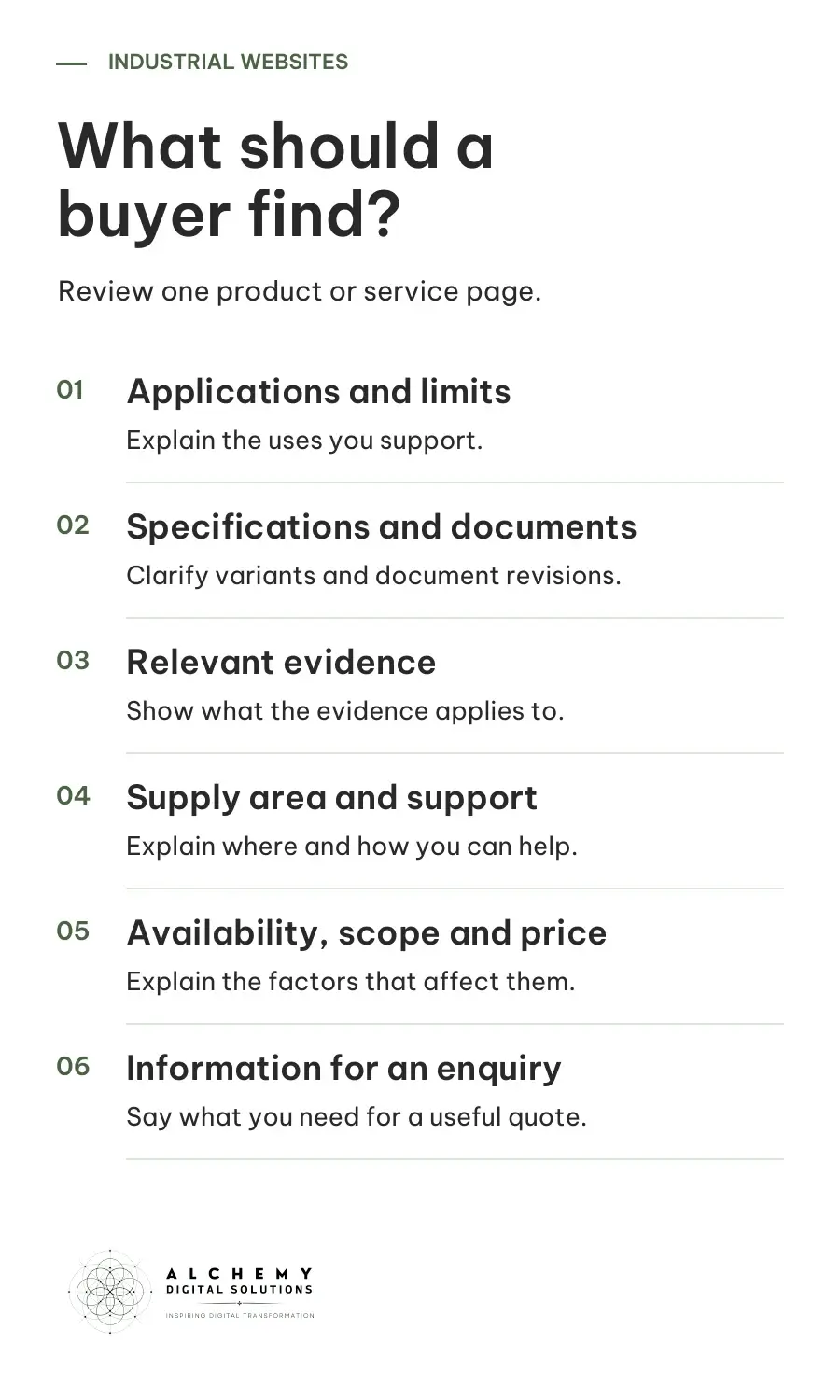
Review a page with someone who handles technical enquiries. Can a prospective buyer find:
The applications you support and any important exclusions?
The relevant specifications, variants and supporting documents?
Evidence that applies to the product or service being considered?
The supply area and available support?
The factors affecting availability, scope and price?
The information needed for an initial enquiry or quotation?
Ask your technical team to check the answers. Prioritise missing information that repeatedly causes unsuitable enquiries or extra clarification.
Discuss your website
Alchemy Digital Solutions offers web design, development and optimisation, including site structure and copywriting.
If your website needs clearer product or service information, send us your website address, the area you want to improve and the questions buyers regularly ask. We can discuss how to make that information easier to find and understand.
For a wider review of traffic, enquiry forms and follow-up, read Why Your Business Website Isn’t Generating Enquiries.

Comments